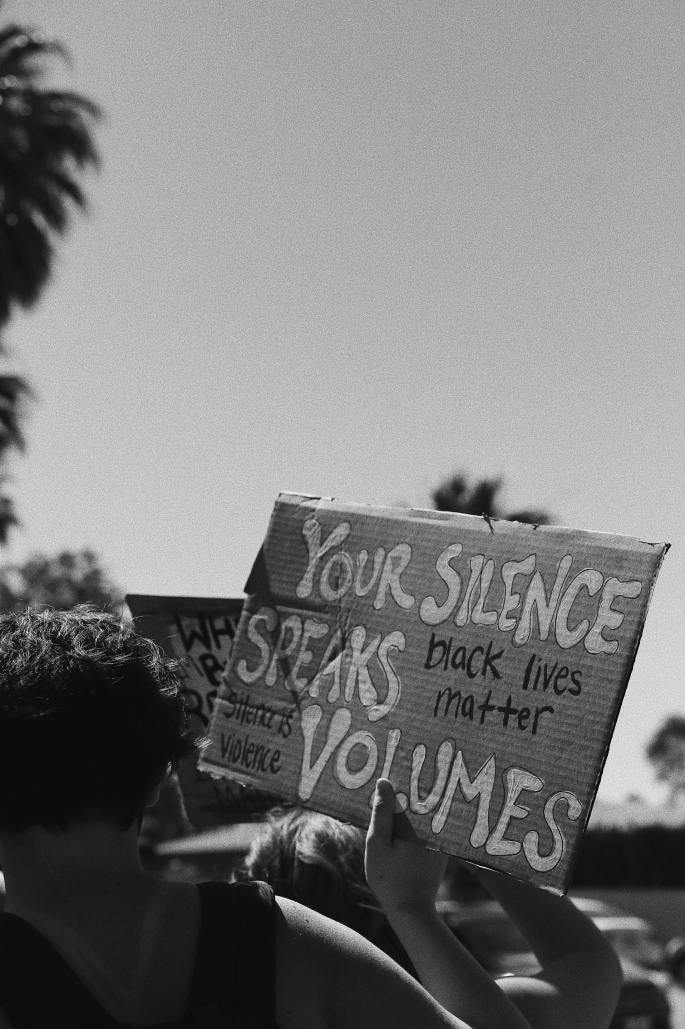
I will not be silent

I will not be silent
in the face of injustice.
I will stand up 
for the oppressed,
for people of color –
children of God.

I will stand up against
the lie of white supremacy
the sin that begat slavery
the sin that begat lynchings
the sin that begets inequality
the sin that begets injustice.

In this land where
liberty and justice
are not for all
I will protest freely
I will act justly
I will love mercy.

I will be an instrument
of Your peace.
Where there is hatred
I will sow love.
Where there is darkness
I will be light.
I will not be silent.

Pillars of Caste: Divine Will

Caste is the granting or withholding of respect, status, honor, attention, privileges, resources, benefit of the doubt, and human kindness to someone on the basis of their perceived rank or standing in the hierarchy.

Isabel Wilkerson

In Caste: The Origins of Our Discontents, Isabel Wilkerson identified eight pillars of a caste system. I would describe these “pillars” as beliefs (or excuses) that are used to justify treating one group of people as inferior to another on the basis of something as insignificant as skin color. A caste system is not necessarily based on race. It can be based on gender, age, religion, social class, etc.

The first pillar Wilkerson discussed is “divine will and the laws of nature.” She began by describing the divine justification for the Indian caste system. In an ancient Indian text, Brahma, “the grandfather of all the worlds” was said to have created the highest caste, the Brahmans, out of his mouth or head. The lower castes were said to have been formed out of lower parts of the body – the arms, the thighs, the feet. The “untouchables” were considered so low, they were even beneath the feet of the lowly Shudra, “the servant, the bearer of burdens.”

In America, Christians historically used what has been called the “curse of Ham” as justification for enslaving people with brown skin. If you read the biblical text, the curse of Ham was actually Noah’s curse of his grandson Canaan, Ham’s son. Noah was angry at Ham for telling his two brothers that he saw Noah naked. The curse was not a curse of God and it had nothing to do with Ham or Canaan’s skin color.

Christians have used selected scripture as a pillar supporting the withholding of privileges from women in ministry. One day, when a woman gave the sermon at my church, I saw a man turn to his wife and say, 1 Corinthians 14:34. I immediately knew that he was referring to the verses that have been used to justify preventing women from speaking in church. “Women should remain silent in the churches. They are not allowed to speak, but must be in submission, as the law says.”

I have struggled to understand why Paul would write that women should not be allowed to speak. I found a compelling response to the question, Are women to remain silent in the church? in a blog post by Dennis Regling, an evangelist. He wrote that Paul often quoted other people before refuting what they were saying. Paul would use the Greek symbol ἢ before refuting the previous passage. The symbol basically means nonsense! or say what?

Both of these examples illustrate how important it is to use discernment when you hear someone attempt to use the Bible to justify something that you know is not consistent with who God is. Our response should be an emphatic . Nonsense! God created human beings in his image. We are to love one another as we love ourselves, to treat other people the way we want to be treated.

****

Photo by Alex Azabache on Unsplash

Toxins in the Permafrost

After the racial protests of 2020, I began reading to learn more about racism in America. The most informative book I have read so far is Isabel Wilkerson’s Caste: The Origins of Our Discontents. Part One of the book begins with a powerful analogy. In 2016, a heat wave hit the Russian peninsula of Yamal. So many children were getting sick from a mysterious illness, the authorities declared a state of emergency. Then scientists discovered that the extreme heat had eroded the permafrost, exposing Anthrax, a toxin that had been buried in the carcasses of reindeer since 1941.

Racism is a toxic pathogen. For much of my life, I believed that America had largely buried it. But just as unusually hot weather in Siberia exposed long-buried anthrax spores, rising heat in human hearts exposed long-denied racism in the United States. What reignited the flames? Wilkens pointed to one catalyst: the U.S. Census Bureau’s projection that by 2042, the U.S. will no longer be a white-majority nation.

The prevalence of racism today is often attributed to institutional or systemic racism, the embedded social practices that lead to discrimination against people of color. According to Wikipedia, the term institutional racism was first used in 1967 in the book Black Power: The Politics of Liberation. Institutional racism is much more subtle and harder to detect than individual racism. Today many whites quickly condemn individual racism as immoral but are not so quick to condemn the racist practices embedded in our culture.

When Martin Luther King, Jr. visited India, he was introduced to a group of high school students as “a fellow untouchable from the United States of America.” King was surprised and a bit peeved to be described as an untouchable. But he realized it was true; he and other black people had been consigned to the lowest caste in America for centuries.

A caste system is an artificial construction, a fixed and embedded ranking of human value that sets the presumed supremacy of one group against the presumed inferiority of other groups on the basis of ancestry and often immutable traits, traits that would be neutral in the abstract but are ascribed life-and-death meaning in a hierarchy favoring the dominant caste whose forebears designed it.

Isabel Wilkerson

Years ago, missionaries visited my church to talk about the Dalits, India’s lowest caste, once known as the “untouchables.” We were given clay cups to remind us of the daily oppression of the Dalit people, who aren’t allowed to drink from the same cups as people in the higher castes. The oppression of the Dalits seemed like an other world problem. Now I realize that caste is very much a part of my world. It is not a foreign problem.

In Caste, Wilkerson draws parallels between the unnamed caste system of the United States and those of India and Nazi Germany. As described by Wilkerson, the upper caste consists of white people of European descent, the middle caste is made up of Latinos, Asians, and Native Americans, and the lower or bottom caste is made up of black people of African descent. White people have historically been the dominant caste, the favored caste, the ruling majority. Black people have historically been the subordinate caste, the disfavored caste, the powerless minority.

In another powerful analogy, Wilkerson compared America to the stage of a long-running play.

The actors wear the costumes of their predecessors and inhabit the roles assigned to them. The people in these roles are not the characters they play, but they have played the roles long enough to incorporate the roles into their very being, to merge the assignment with their inner selves and how they are seen in the world.

Isabel Wilkerson, Caste

White people have become accustomed to our dominant roles. We take little notice of the people in the back unless they try to veer from the script; then we step in and put them in their place. If they protest too much, we silence them.

Caste makes distinctions among creatures where God has made none.

A native of India

The American caste system is a tragedy. As a nation, we have an ugly, horrific history of dehumanizing people based on the color of their skin. And although those of us living today did not create this system, we inherited it and may unwittingly play a role in keeping it in place.

The caste system thrives on dissension and inequality, envy and false rivalries, that build up in a world of perceived scarcity….A caste system builds rivalry and distrust and lack of empathy toward one’s fellows.

Isabel Wilkerson

Today, we can see the American caste system at work in the restrictive voting laws that are being enacted all over the country. I believe that these bills are designed to keep the ruling majority in power. Others have pointed out the symbolism of the governor of Georgia signing a bill that restricts voting rights while surrounded by white men standing in front of a painting of a slave plantation.

I agree with Wilkerson that understanding the American caste system may be the key to dismantling it. In part three of her book, Wilkerson describes what she calls the eight pillars of caste, the beliefs and practices that keep a caste system in place. I will reflect on each of these pillars in future posts.

****

Photo by Daniel Born on Unsplash

Good News in Bad Times

I pray for church pastors who are charged with leading their congregations during these difficult times. They know that the congregation, like the country, is divided politically and that many people are frustrated and angry.

A couple of weeks ago, my pastor encouraged the church to spend more time with Jesus than we spend with our sources of information, whether that be social media or a news/opinion network on TV. He made a really important point. How can a weekly sermon at church override the negative influence of everything we are exposed to outside the church on a daily basis?

I have to admit that I spend more time watching or listening to news/opinion shows every day and reading articles than I do reading my Bible and praying. I know that constant negative news and exposure to the toxins of social media aren’t good for me.

Too much exposure to bad news and negative people can take our eyes away from the hope we have in Jesus.

The kingdom of God has come near. Turn away from your sins and believe the good news!

Jesus, Mark 1:15

No matter what happens in this world, the good news of the gospel is still Good News!

****

Photo by Jesse Gardner on Unsplash

Listening to black voices

To learn more about racism in America, I read two books written by black men. The first one was Tears We Cannot Stop, by Michael Eric Dyson. The second was Between the World and Me, by Ta-Nehisi Coates. Dyson wrote his book to white America. Coates wrote his book to his fifteen-year old son. Both men wrote about the suffering, despair, and fear that result from racism and about the terror of police brutality.

Two perspectives…

Inside the covers of Dyson’s book are the words, “how we can make it through the long night of despair…to the bright day of hope.” Dyson, a professor at Georgetown University and an ordained minister, wrote his book as a sermon to White America because we need to hear the blunt, honest truth about the consequences of the “original sin” of slavery. Although the “sermon” was tough to read, Dyson softened his message by referring to the white reader as “beloved.”

Coates, a national correspondent for The Atlantic, wrote about growing up in fear in Baltimore. He went to Howard University and read extensively about black history trying to understand the divide between the black life he knew and the white American Dream.

When Coates heard his son crying after learning that Michael Brown’s killers would go free, he did not reassure him that everything would be okay. He told him “that this is your country, that this is your world, and you must find some way to live within the all of it.”

Somewhere out there beyond the firmament, past the asteroid belt, there were other worlds where children did not regularly fear for their bodies.

Ta-Nehisi Coates, Between the World and Me

As a man of faith, Dyson believes in the power of redemption. Coates does not believe in God and never believed that a just God is on his side.

Throughout his book, Coates frequently referenced black bodies, starting with the opening line: “Son, Last Sunday the host of a popular news show asked me what it meant to lose my body.” Later, he wrote that the question of his own life was how to live “within a black body, within a country lost in the Dream.” “White America,” he wrote, “is a syndicate arrayed to protect its exclusive power to dominate and control our bodies.”

I was puzzled about why Coates kept referring to black bodies. People of color aren’t just bodies – they have hearts and souls just as I do! Then I thought about America’s long history of owning and controlling black bodies. Black bodies were treated like property, as less than human. Black bodies were segregated from white bodies. White people controlled where blacks could work and go to school. White people controlled where black people could live and eat. Even today, many whites act like black bodies are disposable. We see again and again that whites have the power to slay black bodies with impunity. Coates was telling his son, your black body belongs to you. You will also have to learn how to live in this country within a black body.

Inventing Whiteness

Dyson wrote about the invention of “whiteness.” Whiteness is not genetic; it is a social “inheritance.” Whiteness is privileged in America not because there is a legitimate reason to be privileged but because people with white skin have made it so. Whiteness took various ethnic identities – German, Italian, Jewish, etc. and built them up into another identity. Whiteness is willfully ignorant of black life. Whiteness is a defensive shield that keeps whites from facing the realities that blacks have always known. Whiteness keeps whites from being empathetic – from putting themselves in another’s shoes.

Paraphrasing James Baldwin, Coates frequently referred to people with white skin as “people who think they are white” or “people who want to be white.” Coates wrote that “race is the child of racism not the father.” There have always been differences in skin color and hair. Believing that skin color can be used to organize social hierarchies is the idea of “people who have been brought up hopelessly, tragically, deceitfully, to believe that they are white.”

The Five Stages of White Grief

Dyson wrote that whites have been grieving for years over the loss of our dominance and preferential position in history. He described what he called five stages of white grief:

  1. Pleading ignorance about black life and culture
  2. Denying any responsibility for racism
  3. Appropriating black culture, history, identities
  4. Revising racial history
  5. Diluting or minimizing racism

Many whites do react with anger and denial as in the stages of grief at the loss of a loved one (anger, denial, bargaining, depression, acceptance). However, the responses of whites to racial issues are not stages or phases that whites will get over once we work through anger and denial. I wish that it were so.

Much of what Dyson wrote about white grief are examples of white fragility. Whites are defensive and protective of the status quo. Many whites refuse to admit the reality of black life in America. We promote a racially blind version of history. We forget or “disremember” our horrible past and refuse to acknowledge the ongoing consequences. We claim to be colorblind. We try to minimize the effects of racism by saying that bad things happen to everyone.

Terror of policing

Both writers explained, through experience, why black people are terrified of the police. Dyson told a story about his son, an anesthesiologist, who was stopped by a policeman while driving a rental car with his five-year old in the back seat. The cop told him it was illegal to drive and talk on a cell phone at the same time. Dyson’s son had not been talking on the phone; it had fallen on the floor when he turned the corner. The more he tried to politely insist that he had not broken the law, the more upset the cop became. He placed his hand on his gun. He asked Dyson’s son if he was stupid. The cop said, I should take you to jail and I would, but I have no place to put a child. He gave him a ticket and a warning and said if I ever see you again, I will take you to jail. Imagine facing this hostility and knowing you could have died because you drove while being black.

Sadly, stories like this are not unusual. This summer, I read about Elijah McClain, a 23-year old black man from Aurora, Colorado, who was reported as suspicious because he was waving his arms, dancing while walking to the store. The cops placed him in a chokehold. He tried to explain, I don’t do that stuff. I don’t even kill filies. A paramedic injected him with ketamine to subdue him. Elijah McClain had a heart attack and died within a week. Twenty-three years old.

I can’t breathe. I have my ID right here. My name is Elijah McClain. That’s my house. I was just going home. I’m an introvert. I’m just different. That’s all. I’m so sorry. I have no gun. I don’t do that stuff. I don’t do any fighting. Why are you attacking me? I don’t even kill flies! I don’t eat meat! But I don’t judge people, I don’t judge people who do eat meat. Forgive me. All I was trying to do was become better. I will do it. I will do anything. Sacrifice my identity, I’ll do it. You all are phenomenal. You are beautiful and I love you. Try to forgive me. I’m a mood Gemini. I’m sorry. I’m so sorry. Ow, that really hurt. You are all very strong.

Many whites deflect when the subjects of police brutality or discrimination come up. They bring up black on black crime, disregarding the prevalence of white on white crime. They say, they shouldn’t have run. They should have cooperated. But as Dyson wrote, no matter what we do, the cops come for us. It doesn’t matter if we’re polite and tame, we’re seen as a menace and a threat. Blackness is viewed as criminal and as less than human.

This breaks my heart.

The Plague of White Innocence

We are afraid that when the tears begin to flow, we cannot stop them.

Michael Eric Dyson

Whites do not like to be challenged on racial issues. When blacks bring injustice to our attention, we often react with indifference or deafening silence. Or we blame the victims of injustice. Dyson urged White America to let go of our whiteness and find our humanity. We should accept accountability for our collective capacity for terror. We have to accept responsibility for accepting a privileged way of life that comes at the expense of people of color. We should surrender our innocence and face the truth with all the discomfort it brings.

At the end of his book, Coates told his son, “I do not believe that we can stop them, Samori, because they must ultimately stop themselves.” “Hope for them. Pray for them, if you are so moved.”

Lord, I pray for white America. I pray that we will listen and respond with empathy and compassion to the voices of our beloved black brothers and sisters and that we will stop defending a way of life that is unjust. I pray that we will acknowledge our collective responsibility for the sin of racism. Amen.

****

Photo by Taylor Simpson on Unsplash