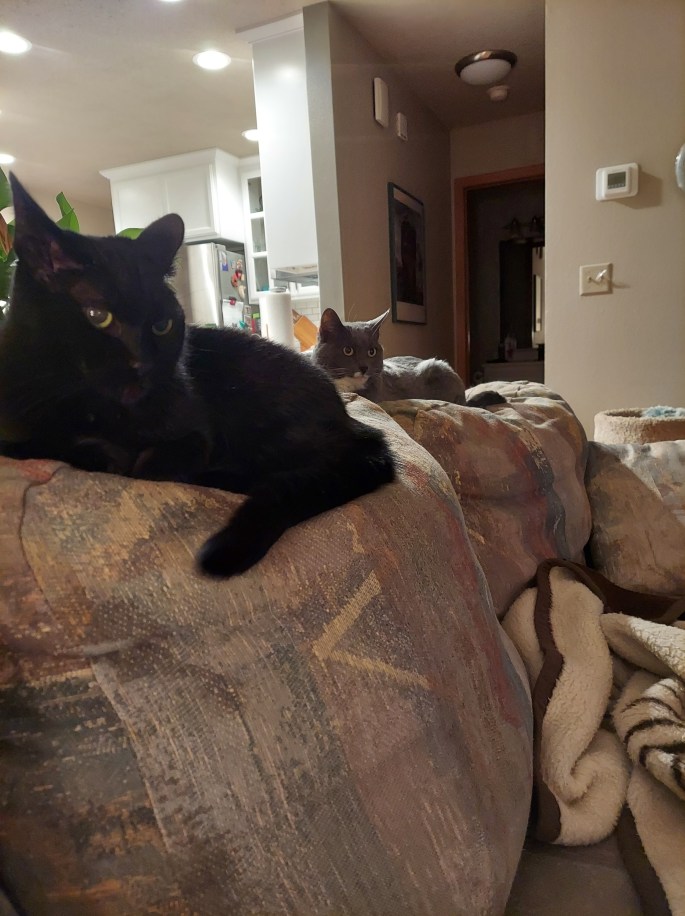
A different species

When you were five, what did you want to be when you grew up?

I remember my kindergarten teacher asking this question when I was five. She did not approve of my answer: a cat. She expected me to give the standard response, something I actually could be – nurse or teacher, perhaps. But I was just a child with a child’s imagination, and I loved cats. I still do.

It’s sad that I began my school years with a woman who did not understand small children. Her name was Mrs. Knowles. She was old and cold and stern.

I have a couple of other memories from that school year. Before school started, we moved from my mom’s home state of Indiana to my dad’s home state of Kansas. It’s strange that I do not remember this, but my brother says Mom left us. She left Dad with four or five kids ranging from one to nine years old. (I don’t know if Mom took the one-year old.) Dad did not know what to do. So he packed up his kids and drove to Kansas, and we moved in with my grandparents until he could find a home. Mom eventually rejoined the family.

I remember Mrs. Knowles asking if I wanted a carton of milk at snack time. I didn’t have any money, so I said no. I believe one carton cost a nickel. I came back to school the next day with milk money. She said, “I thought you didn’t like milk.”

I remember the class skipping around a circle. Mrs. Knowles told me that I didn’t skip correctly. I wasn’t lifting my knees high enough.

At five years old, I felt misunderstood. I gave the wrong answers. I didn’t even move right. I had much better teachers after Mrs. Knowles, but I continued to feel like a different species.

Creative Play

What was the last thing you did for play or fun?

I am not a creative person by nature. A couple of my sisters are, though, and when we get together, they find creative projects to do.

A couple of years ago, we painted little sleds.

Recently, I saw a picture of a wreath made with wine bottle corks. There was a link to the crafter’s website that explained how to make one. It looked like something that even I, a non-crafty person, could do.

I had been saving wine bottle corks for years, with the intention of eventually making something with them.

I bought a straw wreath base and used a glue gun to glue corks around the outside and inside of the wreath. Next, I glued corks on the surface randomly, which was perfect for a non-perfectionist. I salvaged decorative items, including little pine cones and plastic grapes, from other Christmas decorations and attached them to the wreath. The result is not perfect, but I think it turned out pretty well.

More importantly, it was fun! I got to play with my glue gun! And my cat had fun batting corks around the room!

Mixed Feelings

What are your feelings about eating meat?

I have always been a meat eater. I also love animals. I hate the thought of animals being mistreated.

Meat is a great source of protein, an essential nutrient. My husband and I eat primarily beef, poultry, and pork. He loves meat a lot more than I do. If it was up to me, we would eat less red meat for health reasons. But I need the iron it provides.

Our last house backed up to a pasture where cows grazed. I like cows! Of course, I knew they would ultimately be butchered. It made me feel better knowing these cows had a good life, walking around eating grass. I don’t feel good knowing that cattle and hogs are raised in feed lots.

Now, we live in a condominium community frequented by wild turkeys. Thankfully, these turkeys will not end up on anyone’s dinner plate.

I feel some guilt knowing that the animals we consume may be confined and raised in horrible conditions. I try not to think too much about it.

Contentment

Earlier this year, a Day One prompt asked a really good question:

What positive emotion do you feel most often?

My normal emotional state is contentment. Contentment doesn’t mean that I have everything I want. Contentment doesn’t mean everything is going well in my life. Contentment is not dependent on the circumstances.

Daniel Cordaro asked, What if you pursued contentment rather than happiness? Cordaro quoted Dr. Dorji Wangchuk, who said that contentment is “the highest achievement of human well-being.”

Cordaro shared the origin of the word contentment.

The root of the word contentment comes from the Latin contentus, which means “held together” or “intact, whole.”

Contentus asks the question, “How whole do you feel inside? How complete are you as a human being?”

Daniel Cordaro

Cordaro and his team concluded that human beings use two strategies to achieve well-being – what they called a More Strategy and an Enough Strategy. The More Strategy is used by people who try to achieve happiness by getting more of something external – more money, more stuff, more recognition, etc.

King Solomon would surely have agreed that the “more strategy” is pointless. In the book of Ecclesiastes, Solomon, a man of great wisdom, concluded that striving for wealth and achievement is meaningless, like chasing after the wind.

I denied myself nothing my eyes desired;
    I refused my heart no pleasure.
My heart took delight in all my labor,
    and this was the reward for all my toil.
Yet when I surveyed all that my hands had done
    and what I had toiled to achieve,
everything was meaningless, a chasing after the wind;
    nothing was gained under the sun.

Ecclesiastes 2:10-11 (NIV)

People who find the source of well-being within themselves practice the Enough Strategy. Their lives have value regardless of wealth, social status, or achievement.

To be content means you have enough, regardless of what is going on around you. Contentment means being satisfied with your lot in life.

To be content regardless of circumstances, I process all the emotions I experience – good or bad – and find the strength within myself to manage them. Circumstances may get me down, but I can’t stay down. I change the circumstances if I can. I adjust my expectations. I practice gratitude. I never give up hope.

My source of well-being isn’t just within myself; I believe in a higher power. God has promised to work things out for the good of those who love him. I put my trust in him.

The Apostle Paul understood the “enough strategy.” He was beaten and imprisoned for spreading the gospel, yet learned to be content.

I am not saying this because I am in need, for I have learned to be content whatever the circumstances. I know what it is to be in need, and I know what it is to have plenty. I have learned the secret of being content in any and every situation, whether well fed or hungry, whether living in plenty or in want.

Philippians 4:11-12

I have been through some trials this year. I expect the next few years to be difficult. Even so, it is well with my soul. I am holding myself together. I have much to be thankful for. I have hope.

Change one ❤️

What change, big or small, would you like your blog to make in the world?

This is the kind of meaningful question I like. What difference do I want to make in the world by blogging?

I named my first blog, The Dirty Cup, a reflection of my desire, my need, to be changed on the inside. I want to have a clean heart. I do not want to be like the hypocrites that Jesus scolded.

Woe to you, teachers of the law and Pharisees, you hypocrites! You clean the outside of the cup and dish, but inside they are full of greed and self-indulgence. Blind Pharisee! First clean the inside of the cup and dish, and then the outside also will be clean.

Matthew 23:25-26 (NIV)

Although I later abandoned that blog altogether, writing it changed me. Or I should say that God changed me. I grew spiritually.

I am still growing through this blog, Innermost Being. The title was inspired by King David, the psalmist. He wanted God to examine his heart and to change him.

Search me, God, and know my heart;
    test me and know my anxious thoughts.
See if there is any offensive way in me,
    and lead me in the way everlasting.

Psalm 139:23-24

Here’s what AI says about the words Innermost Being:

The term “innermost being” can refer to the core of a person’s being, or their inner self, which is the private, internal part of themselves that they usually don’t share with others. It can also refer to the deepest aspects of human nature, which are known only to God and are different from a person’s public image or outward appearance.

My outward appearance is not important.  What’s really important, as Jesus said, is my heart. Am I loving others as God loves me? Am I cultivating fruit of the Spirit? Love, joy, peace, patience, kindness, goodness, faithfulness, gentleness, and self-control?

I don’t expect my blog to change the world in a big way. I just hope that if I share my perspective on life, if I share my own struggles, I can soften one heart.