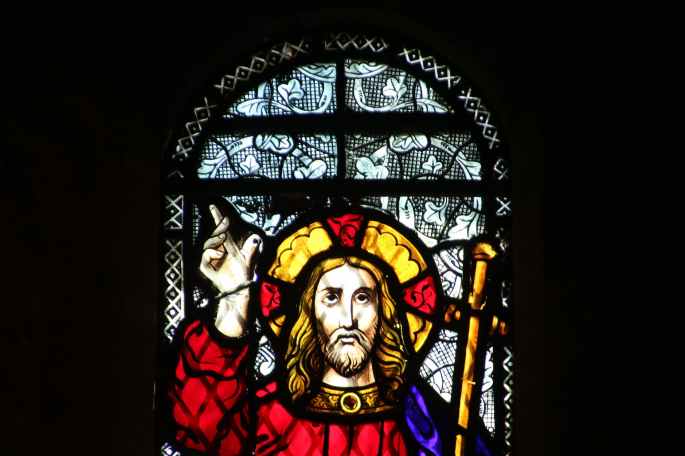
The Lord is my shepherd

I am studying Dallas Willard’s book, Life Without Lack: Living in the Fullness of Psalm 23. The author recommended memorizing the 23rd Psalm. I now recite it to myself when I wake up at night and want to quiet my mind.

The first chapter is about the Lord our God. With our limited minds and senses, we can’t form a complete, realistic conception of God. Jesus Christ, through his example and his teaching, showed us what God is like in a way we can understand.

Our minds are our portal to God

Willard says that the most important thing about you is your mind, and the most important thing about your mind is what you think about. When you keep your mind focused on God, he will make himself known to you.

Willard says that when we are wounded, it may cause us to become self-obsessed. I think human beings are naturally self-centered, whether or not we’ve been injured. There are many things that keep us from thinking about God – pride and selfish ambition, greed, envy, and self-indulgence. Even the concerns of daily life cause us to focus on ourselves.

God’s invisible qualities

God is invisible. But his invisible attributes are made known to us by creation. Through the things he has made, we can see his power, his glory, his creativity, and his intelligence.

For since the creation of the world God’s invisible qualities—his eternal power and divine nature—have been clearly seen, being understood from what has been made, so that people are without excuse.

Romans 1:20

God is personal. He wants to have a relationship with us. He has personality. He thinks. He creates. He values. He feels.

God is energy

The powerful forces of the natural world – the sun, wind, thunder, and lightening – give us just a glimpse of God’s energy. God is energy in a form that is incomprehensible to us because it is so immense.

Willard noted that when the Israelites wandered in the wilderness, God’s presence was made known by a pillar of clouds by day and a pillar of fire by night (Exodus 13:21). John the Baptist said that Jesus would baptize with the Holy Spirit and fire (Luke 3:16).

When we make contact with God, a flow of energy comes to us.

Dallas Willard

When God speaks, his voice is a form of energy that becomes matter. He spoke our world into existence. Jesus turned energy into matter when he multiplied fish and bread to feed thousands of people (Matthew 14). Power flowed from the body of Jesus when he healed a bleeding woman who touched him (Mark 5:25-30).

God’s names

The meaning of the names used for God in the Old Testament reveal truths about who God is. Yahweh means that God brings into existence or causes to be. Elohim refers to his creative strength, power, and majesty. Adonai means my Lord or master. El Shaddai means Almighty God or the All Sufficient One. When Moses asked God what he should say if the Israelites asked, “What is his name?” (Exodus 3), God said I am who I am. The name Immanuel means God with us (Isaiah 7:14).

The Lord’s prayer says, “Hallowed be thy name.” To know God, we must keep these truths about who he is in our minds at all times.

Adonai is my shepherd. I shall not want. He makes me lie down in green pastures. He leads me beside still waters. He restores my soul.

Immanuel leads me in the paths of righteousness for His name’s sake.

Yea, though I walk through the valley of the shadow of death, I will fear no evil. For El Shaddai is with me. Your rod and your staff, they comfort me.

Jesus prepares a table for me in the presence of my enemies. You annoint my head with oil. My cup overflows!

Surely goodness and mercy shall follow me all the days of my life, and I will dwell in the house of Yahweh forever.

Examining the Divide in Christianity Today

For thine is the kingdom, and the power, and the glory, for ever.

Tim Alberta used the closing line of the Lord’s prayer in the title of his book, The Kingdom, the Power, and the Glory, subtitled American Evangelicals in an Age of Extremism. As a reporter, Alberta went to places where I would never go and spoke to people with whom I would not associate (because our values differ too much). His book is disturbing, but it gave me insight into the damage false prophets and their followers have done and continue to do to Christianity.

Alberta noted that Christian conservatives are now Donald Trump’s “most unflinching advocates.” Given DT’s immorality and unrepentance, as a follower of Christ, I can not help but ask the question that prompted Alberta to write his book: Why

I also ask myself, What can I do to counteract the damage that has been done to  Christian witness? How can I disciple Christians who have been seduced by false teachers?

As Alberta wrote, it isn’t fair to lump all Christian Trump supporters into one homogeneous group. They fall along a continuum. Like Alberta’s, my conservative Christian friends have “to some extent been seduced by the cult of Trumpism.”

An interviewer asked Alberta if he really believes that evangelicals are divided into two camps, as he implied when he tweeted that there are Russell Moore Christians and Jerry Falwell Jr. Christians. Alberta says he fumbled in his response, not stating his position clearly. He responded that some Christians see issues through the eyes of Jesus, while others process everything through a partisan lens. The truth is, Alberta sees evangelicals as either “faithful to an eternal covenant” or “seduced by earthly idols of nation and influence and exaltation…” In other words, one camp has its eyes set on this earthly kingdom, political power, and the exalting of people, not on God and his kingdom.

Evangelicals are not easy to define. Today, the description is frequently used as a cultural or political identity. At one time, evangelicals were born again Christians, characterized by activism – sharing the gospel (the good news) so that others might believe in Christ and be born again. There are still Christians who believe this is our mission. However, with the influence of groups like the “Moral Majority” in the 1980s and the Heritage Foundation today, a growing faction of Christianity has been transformed into a partisan political movement.

Alberta’s book is structured around how politicians, Christians, and others have attempted to coopt the kingdom, the power, and the glory that belong exclusively to God.

God has His own kingdom.

God has His own power.

God has His own glory.

Earthly kingdoms like the one envisioned by conservative Christians and politicians can not compare to the kingdom of God.

No amount of political or cultural power, not even the amount DT and wealthy political donors hold, can compete with the power of God.

The glorification of DT by the Trump cult and his own self-aggrandizement can’t hold a candle to the glory that belongs exclusively to God.

Alberta ended the book’s prologue with this admonition – you can not serve and worship both God and the gods of this world. Christians must resist idolatry. We must reject our worldly identity if we want to become more like Christ, the author and perfector of our faith.

The state of Christianity in the U.S. today is an unpleasant topic that’s been bothering me for years. It isn’t getting any better. The extremism persists. The false witnesses drown out the witness of the faithful. I feel called to resist the false witness.

Heavenly Father, the Kingdom, the Power, and the Glory are yours forever.