Innermost Being Blog

A Community of Feeling

I sympathize with anyone who experiences the loss of a loved one because I have experienced grief myself. To sympathize with the pain of another is to join a community of feeling. When I offer condolences, I hope that the person is  comforted in knowing that they are not alone. I know that when my mother passed away a couple of year ago, I was comforted by the many expressions of sympathy I received from friends.

The emotions of sympathy and empathy are often confused. When we sympathize, we share the feelings of another person. We feel what they are feeling, whether it is grief or disappointment or frustration because we have had similar emotional experiences. When we empathize with another person, we understand or relate to their feelings because we can imagine what it would be like to be in their shoes.

There is a fine line between sympathy and empathy. For example, I will never know what it is like to lose a child because I don’t have children. I can only imagine how painful and heart-wrenching it is. Having experienced grief myself, I can imagine the feeling of loss, but I can’t fully feel what a mother feels in losing her child.

Even though empathy is not based on shared experience, I treasure the ability to consider things from another person’s point of view. You never really understand a person unless you can empathize with them. Empathy makes us more compassionate, more humble, more helpful. There, but for the grace of God, go I.

You never really understand a person until you consider things from his point of view . . . until you climb into his skin and walk around in it.

To Kill a Mockingbird, Harper Lee

via Daily Prompt: Sympathize

Thank you, problem solver

Last year, I read a book by John Bargh. It was called Before You Know It: The Unconscious Reasons We Do What We Do. I was especially interested in what Bargh wrote about the problem solving abilities of the subconscious mind. When you step away from a problem you are working on and think about something else, the subconscious mind continues to work on a solution.

This week my conscious mind worked really hard trying to solve a problem at work. I had found an error in the income tax accrual related to an item in prior year financial statements. The tax accountant said that tax returns would have to be amended and perhaps financial statements would have to be restated. There would be penalties and interest. I had been proud of myself for finding and correcting an error, but by doing so, I had opened a can of worms.

I was puzzled about what to do. How would we explain this mistake to the client? I spoke to the woman who prepared the prior year reports and I dug around to find documentation supporting the prior year numbers, then I went home for the night.

Thanks to my subconscious mind, I realized I needed to check the work of the CPA firm. They make mistakes too. What I found was good news. The tax return was accurate and doesn’t have to be amended. There won’t be penalties and interest.

A new day brings a rested conscious mind and a fresh problem-solving perspective. Thank you subconscious for working while I sleep.

via Daily Prompt: Puzzled

To have an inkling

To stretch my writing muscles, I have made several attempts this month to write in response to daily word prompts. I will admit that I only do so if the word grabs me in some way. Today the prompt is “inkling,” a word that reminds me of my childhood. I rarely hear anyone today say they have an inkling but I think my mother said it a time or two. She also used to ask, “how does that grab you?”

I looked online for the meaning of “inkling” and the phrase “have an inkling.” An inkling is a slight knowledge or suspicion, a hint. And according to The Phrase Finder, “there isn’t much we can do with an inkling other than to have one.”

What else can you do with a slight suspicion than have it? Well, you can reject it or trust it or dig further to find out if your inkling is right. My mother taught me to trust my instincts. Sometimes all you need is a little knowledge, a little hint to know what you should do.

This is the second time in a week that a word prompt has reminded me of my mother. A few days ago, the word was silhouette and I remembered a silhouette someone made of my mom’s profile. One of my siblings probably has it. I spent several minutes poring through my little sister’s photo collection on Facebook but didn’t find it. I found memories instead.

I miss my mom and I miss her silhouette and I miss her idioms. Grief sure comes at the strangest times with little prompting.

via Daily Prompt: Inkling

Trying to Understand the Inscrutable

I am part of a small group of women who meet a couple of times a month for a Bible study. I am the oddball of the group. The five other women are ultra conservative. I guess I am best described as a progressive. I am most definitely in favor of social progress and improvement, whether it is improving access to affordable healthcare, protecting the environment, promoting voting rights and the equality of women, etc. I don’t want to go backwards. I don’t want to maintain things the way they are.

This is not the first time I have been the oddball in a koinonia – a group of believers who get together for support and fellowship. The last time I was so disturbed by right-wing political comments (calling Obama the antichrist and a socialist) that I dropped out of the group even though I genuinely liked the women. This time, I am trying to hang in there and love my friends despite our very different understandings of what it means to follow Christ.

Case in point: Last night, one of the women made an inscrutable comment in response to a question in our study book: How have you seen God use surprising people and circumstances to accomplish his will in this world? She said she heard that the current administration reads more scripture than any administration since JFK and his cabinet meetings start off with prayer.

I was not speechless, though it’s difficult for me to remember all my words when I am emotional about something. I did say, “There may be religious people at his meetings but I think he is a wicked man.” Another woman said, they say he recently became a Christian. I said, “I don’t believe it. If he were truly saved he would be remorseful and repentant about the things he has said and done. He would not denigrate people the way he does.”

For the past couple of years as I have watched Christians support the wicked man who now occupies the oval office, I have vainly tried to make the inscrutable scrutable. I’ve tried to understand why people who follow the moral teachings of Jesus are so willing to ignore the immorality and hatefulness of the president.

I can’t make sense of it.

I understand confirmation bias; we listen to the arguments that fit our worldview. I understand that people have fears for the future. I understand that people have certain ends in mind when they vote.

I don’t understand consequentialism – the idea that the ends justify the means. Christians wanted a man who would appoint a conservative judge to the Supreme Court so they were willing to ignore his wickedness. They struck a bargain with a bigot.

The problem with consequentialism is the collateral damage that comes with the means. Is the country more moral with a pathological liar in the white house? Are we any better at loving our neighbors – other nations – with a nationalist at the helm? Is it worth risking the right to free speech when the emperor cries out “fake news!” every time the press points out that he has no clothes? Are we better at protecting the needy with a selfish, greedy man shaping governmental policies?

Try as I might, I can’t make the inscrutable scrutable.

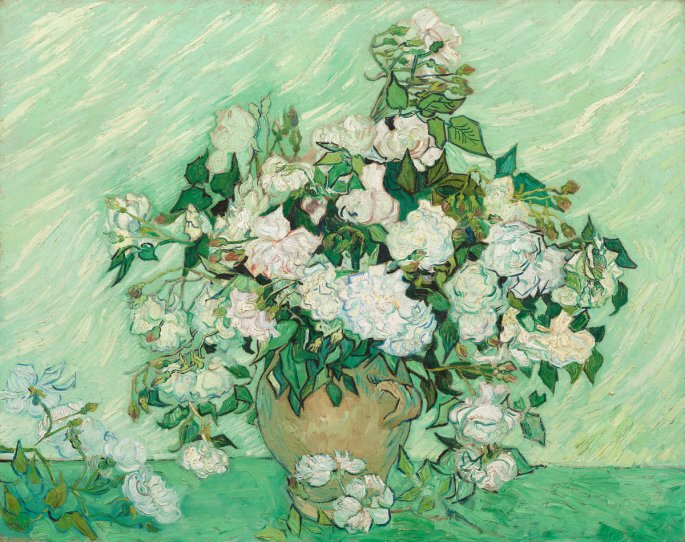
Image credit: Vincent van Gogh, Courtesy National Gallery of Art, Washington

via Daily Prompt: Inscrutable

Dominant Issues

On Saturday, while I waited for the Women’s March to start, a woman gave me a stamped postcard to send to my Republican senator. I seriously doubt that the senator gives a crap what I think but I decided to send the card anyway. The card has a tiny space to write what I’m concerned about and why. There’s no way I can adequately explain my political concerns on a postcard but I did my best. The three words I listed as dominant issues are loaded with meaning: Democracy, Decency, and Dreamers.

Democracy

I’m concerned about our democracy for a variety of reasons. There is ample evidence that Russians attempted to interfere with our election process. Even if the president had won the election fair and square, his authoritarian tendencies are alarming. He seeks revenge against his political opponents, especially HRC. He encouraged violence at his worship services, I mean, his rallies. He attacks the legitimacy of the press on a daily basis because they expose the truth. He attacks the integrity of the Justice Department and the FBI because their job is getting to the truth. So far, the judicial branch has placed limits on his power but the legislative branch has not been an effective check.

Decency

Decency refers to “behavior that conforms to accepted standards of morality and respectability.” The president violates accepted standards on a daily basis. He lies constantly, even about unimportant matters. His comments about other people are vile, cruel, and profane. His constant boasting is revolting. As a businessman, he stiffed his creditors. He is a serial adulterer who has bragged about assaulting women.

Dreamers

“Dreamers” are immigrants, mostly from Mexico, who were brought to the United States as children. Although I care about all immigrants and refugees, I think that protecting Dreamers should be a priority because they are here through no fault of their own.

Mr. Gardner, not only do I hope you understand these issues, I hope you take your responsibilities seriously. I’m watching and waiting.

via Daily Prompt: Dominant