Imagine a man

Imagine a man whose heart is far from God. He puts many gods before the one true God but the god who has a real hold on his heart is the god known as Self. The one true God is higher than any other god. He alone is all powerful and all knowing. He alone is worthy of all honor and praise. The one true God is the God of love and the source of all that is good. The man whose heart is far from God follows a god of hate. His god brings forth that which is evil.

The man whose heart is far from God expends an extraordinary amount of energy elevating the god of Self – boasting about how smart he is, how wealthy he is, how powerful he is. He exalts himself over everyone and everything. He knows more about any subject than anyone else. In his own eyes, no one is greater in all the earth. He never admits failure, never confesses a wrong, never acknowledges weakness or self-doubt. When he is not elevating the god of Self, he busies himself tearing down his enemies – anyone who makes the god of Self look bad. His greatest enemy is the truth and he fights the truth with a vengeance.

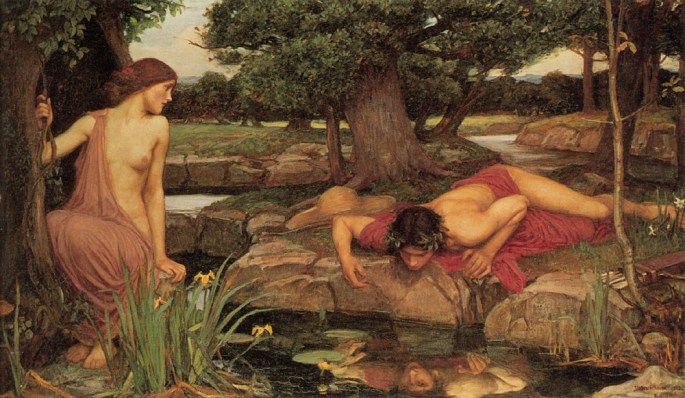
Imagine Narcissis gazing adoringly at Self in the mirror. Self-aggrandizement. Self-adulation. Self-importance. Self-indulgence. For the man whose heart is far from God, it is all about Self.

The man whose god is Self is a master manipulator, a master of deception, a conman. He belongs to his Father, the devil, the father of lies. He carries out his father’s desires. There is no truth in him. When he lies, he speaks his native language.

No man is perfect. We all sin. We all fall short of the glory of God. None of us knows everything. We all fail. We all stumble. But the man whose god is the god of Self will never admit this. He will never repent. He lives in a world of make believe, a world of fantasy and unreality. When he looks in the mirror he sees a distorted version of himself.

His most consequential lie is a powerful self-delusion. The fool says in his heart, “There is no God.” He tells himself, if there is a god, I can deceive him just as I deceive people.

The man who worships the god of Self surrounds himself with oleaginous sycophants, toadies, boot lickers. They see his nakedness but pretend that the emperor wears the finest clothes. Convinced that the ends justify the means, they flatter and praise him to stay in his good graces and to trade on his influence.

The man who is his own god believes he is above the law. Many men have tried and failed to hold him to account. The truth is, every man will have to account to God for every wicked act, every careless word. Imagine the day when the man who has spent his life worshiping Self finally faces his Maker. He will not get away with lying to the Father of truth. He will not impress the omnipotent, omniscient God with his wealth, power or intelligence. He will not escape God’s judgment by deflecting and blaming others.

The man whose heart is far from God is not a figment of my imagination. He is real. He is an old man but there is a childlike quality about him. There is something sad and pathetic about his constant need for adulation. He is rich in material wealth but morally bankrupt. He is seemingly successful and yet a colossal failure. He is a powerful liar but he cannot change the truth. He presents himself as a savior but he cannot save his own soul.

I had a dream about this man a couple of months ago. I said one word to him. Repent. The man whose heart is far from God is not beyond God’s redemption. I pray that he will be humbled before the one true God before it is too late.

****

By John William Waterhouse – http://www.allartpainting.com/echo-and-narcissus-p-16444.html, Public Domain, https://commons.wikimedia.org/w/index.php?curid=7716057

A Prayer for My Country

Father, I have been struggling to put the prayer of my heart into words. As much as I want to believe that this country can be united by a shared interest in slowing the spread of the coronavirus, it is wishful thinking. Many people resent restrictions on their freedom even if the purpose is to protect the safety and well being of all of us. People are understandably worried about the survival of small businesses. People understandably want things to get back to normal. People are understandably tired of staying home.

I want to pray for unity but I am a realist. This country has been divided for years. Divided by ideology, divided by an “us versus them” mentality. The same issues and mindsets that divided us before this pandemic divide us now. The other side is still the enemy.

Lord, you told Isaiah to go and tell the people,
‘Be ever hearing, but never understanding;
be ever seeing, but never perceiving.’
Make the hearts of this people calloused;
deafen their ears and close their eyes.
Otherwise they might see with their eyes,
hear with their ears,
understand with their hearts,
and turn and be healed.

Father, I have no illusions that this is a Christian nation. It is a nation with millions of Christians who worship you in Spirit and in truth and millions who are Christian in name only. A vast majority has turned its back to You. They have other gods before You. The hearts of this nation are calloused. Otherwise, they might hear with their ears and understand with their hearts, and turn and be healed.

Lord, before there can be unity, there must be healing of hearts. I pray that You will use this pandemic to turn people to You. Help the people of this nation to see the truth with their eyes, to hear the truth with their ears, and to understand with their hearts.

Amen.

Photo by Hasan Almasi on Unsplash

The Sacrament of Living

I finally finished rereading The Pursuit of God. In the last chapter, A.W. Tozer wrote about the way too many Christians divide their lives between the sacred and the secular. We have life in the Spirit but live in the natural world. The two parts of our lives may seem starkly different and separate. Tozer said that if we try to “walk the tightrope between two kingdoms,” we will not live a unified life. We will not experience internal peace.

All for the glory of God

Religious activities that Christians engage in – praying, worshiping, reading the Bible, singing songs of praise, etc. – are meaningful and satisfying because we know they are pleasing to God. As spiritual beings, we have our eyes on the kingdom of heaven and look forward to eternal life in a place where there is no evil and no suffering. But as human beings, we spend our days doing ordinary human things – working, eating, sleeping, cleaning, etc. The ordinary acts of living can seem tedious and frustrating in comparison to sacred acts of worship.

And yet, as the Apostle Paul wrote, we are to do everything – even the most ordinary acts of living – for the glory of God.

So whether you eat or drink or whatever you do, do it all for the glory of God. 

1 Corinthians 10:31, NIV

When Paul wrote to the Colossians, he told them to set your hearts and your minds on things above. He reminded them that as God’s chosen people, they should be kind, humble, gentle and patient. They should love and forgive others. When we work, we are to work at it as if we are working for the Lord. When we serve others, we are to serve as if we are serving Christ.

Whatever you do, work at it with all your heart, as working for the Lord, not for human masters, since you know that you will receive an inheritance from the Lord as a reward. It is the Lord Christ you are serving.

Colossians 3:23-24

Sacramental Living

The dictionary says a sacrament is “a religious ceremony or ritual regarded as imparting divine grace, such as baptism, the Eucharist and (in the Roman Catholic and many Orthodox Churches) penance and the anointing of the sick.” Tozer described a sacrament as “an external expression of an inward grace.” If we accept this truth, then we can see the ordinary acts of our lives as sacred. We can consecrate our total selves to God.

Tozer addressed a couple of issues that get in the way of sacramental everyday living. One is “the sacred-secular antithesis as applied to places.” He asks, how can anyone who has read the New Testament still believe that there is something inherently sacred about a place? In the Old Testament, God taught the people of Israel the difference between what is holy and unholy. What they should have learned is that God is holy; things or places are not holy. In the New Testament, the woman at the well told Jesus, you Jews claim that the place we must worship is in Jerusalem. Jesus said, the time has come when true worshipers will worship the Father in the Spirit and in truth.

A second issue that may get in the way of sacramental living is the ritualism and religious observances in which many Christians engage. Here Tozer directed criticism specifically at the Roman Catholic Church. Christians started out with two sacraments, baptism and holy communion. The Catholic church eventually came to recognize seven. Tozer believed that in adding sacraments and in observing days and times, Catholics and fundamentalists artificially divide religion from everyday life.

Am I walking a tightrope?

When I first started reading what Tozer had to say about the way Christians mistakenly divide their lives between the sacred and the secular, I immediately felt convicted but not for the reasons he laid out. There was no social media when The Pursuit of God was published (1948). In an effort to not offend or alienate nonreligious friends and family on social media, I tend to hold back on expressions of my faith. In a way, this is dividing the sacred from the secular and I am left feeling divided.

While Tozer wrote about the important truth that even laypeople can do ordinary, everyday things for the glory of God, I struggled to get to the truth I was seeking. I already know that I can honor God when I work and do ordinary things. Something was missing from his discussion. My struggle with the sacred-secular dichotomy is not the struggle he described.

At one point, Tozer wrote about sins of the body – “perversions, misuse and abuse” – but then quickly moved on. He said:

Let us think of a Christian believer in whose life the twin wonders of repentance and the new birth have been wrought. He is now living according to the will of God, as he understands it from the written word.

A.W. Tozer, The Pursuit of God

What about those of us whose lives have the twin wonders of repentance and rebirth who still struggle with sins of the heart? It’s easy to be righteous when you’re sitting in church praising God or when you’re reading the Bible or praying. It is everyday, ordinary life that brings out the hard truth that I am still a sinner in need of God’s grace.

The trouble is with me, for I am all too human, a slave to sin. I don’t really understand myself, for I want to do what is right, but I don’t do it. Instead, I do what I hate. But if I know that what I am doing is wrong, this shows that I agree that the law is good.  So I am not the one doing wrong; it is sin living in me that does it.

Romans 7:15-20, New Living Translation

I am all too human, a slave to sin. I want to do what is right, but I can’t. I want to do what is good, but I don’t. I don’t want to do what is wrong, but I do it anyway. In my mind I really want to obey God’s law, but because of my sinful nature, I am a slave to sin. Who will free me from this life that is dominated by sin? Jesus Christ.

While Tozer did not write about the fact that our very humanity separates the sacred from the secular, he acknowledged that old habits die hard. It takes practice to learn new habits. We must offer all our acts to God and pray “a thousand thought-prayers as we go about the job of living.” We must remind ourselves that Christ dwells in us. We cannot be fruitful unless we remain in Jesus and his words remain in us.

Let us believe that God is in all our simple deeds and learn to find Him there.

A.W. Tozer

****

Photo by Loic Leray on Unsplash

A Prayer for Aching Hearts

Heavenly Father, thank you for my health and for the health of my loved ones. Lord, everyday I hear about widespread physical suffering and death from the coronavirus pandemic. It is not like anything we have experienced in our lifetimes. Lord, again I pray for doctors, nurses, and nurses aides who put their own health at risk to save lives. Again I pray for essential workers who risk their own health to provide essential goods and services to the public.

Lord, this global pandemic has caused more than physical suffering and financial woes. It has brought widespread heartache. In normal times, doctors and nurses and ministers learn to face the reality of suffering and death. My sister has made a career of caring for the elderly, including our mother. She has seen a lot of death. This pandemic is like nothing anyone has experienced.

When my mother-in-law was dying, we stood at her bedside in the hospital and held her hand as she struggled to breathe. We had the chance to say goodbye. When my mother lay dying in the nursing home, we gathered around her bedside as her organs failed. We kissed her face and held her hand and said our tearful goodbyes.

This is different. When a person is afflicted with a contagious disease, healthcare workers can only approach wearing masks and protective clothing. Doctors and nurses cannot extend a human touch of comfort. Loved ones cannot surround the dying in the last moments of life as we surrounded my mother with love.

Father, this is heartbreaking.

Lord, bless the hearts that break for others. Comfort those who must maintain physical distance to guard against infection, even as they long to comfort the afflicted. Be their personal protective shield against this virus. Give them strength to face each day.

God of mercy, hear my prayer. Amen

Photo by Kelly Sikkema on Unsplash

Meekness and Rest

In one of his most profound statements in the Sermon on the Mount, Jesus said, blessed are the meek for they shall inherit the earth. Even then, this was an astonishing statement. The world sees meekness as weakness. According to Vocabulary.com: “The adjective meek describes a person who is willing to go along with whatever other people want to do, like a meek classmate who won’t speak up, even when he or she is treated unfairly.” Why then did Jesus suggest that meekness is a strength?

In The Pursuit of God, A.W. Tozer pointed out that the world turns every virtue of The Beatitudes wrong side out. Instead of displaying poverty of spirit, mankind displays the worst forms of pride. Instead of mourning sin and suffering, man indulges himself with every kind of pleasure. Instead of walking humbly and meekly before God, man struts around inflated with pride and self-importance. Instead of hungering and thirsting for righteousness, man chases money and things. Instead of striving to be pure in heart, man delights in sin and corruption. Instead of making peace, man quarrels and sows discord. Instead of accepting mistreatment at the hands of others, man fights back with every weapon at hand.

Unlike most people, Jesus was meek and humble. Although he did not fight back when he was treated unfairly, no one would ever claim that Jesus was a pushover who did whatever other people wanted to do.

Come to Me, all you who labor and are heavily burdened, and I will give you rest. Take My yoke upon you, and learn from Me. For I am meek and lowly in heart, and you will find rest for your souls. For My yoke is easy, and My burden is light.

Mathew 11:28-30 (Modern English Version)

Tozer made an interesting connection between the meekness of Jesus and his promise to give rest to those who are heavily burdened. Was Jesus speaking about physical labor? What is this heavy burden borne by mankind?

Pride is a terrible burden. Look at how hard we work to build the self up and to defend the self from insult, slights and criticism. It is hard and tiring labor to constantly fight to protect and defend our wounded pride.

The labor of self-love is a heavy one indeed.

A.W. Tozer, The Pursuit of God.

We don’t have to bear this burden. Jesus calls us to him for rest. Being meek like Jesus is the way we find rest from the heavy burden of pride.

A meek man sees himself honestly, both the good and the bad. He knows that the world will never see him as God sees him. He know that he doesn’t have to be perfect to be beloved by God!

Pretense is also a heavy burden. It takes a lot of energy to pretend to be what you’re not. It takes tremendous effort to always put your best foot forward, to always make a good impression, to craft the perfect social media image. It is indeed a heavy burden to hide the pain, the failures, the awkwardness, the self-doubt, and imperfection.

In Falling Upward: A Spirituality for the Two Halves of Life, Richard Rohr also addressed the issue of pretense but he referred to it as your shadow self.

Your shadow is what you refuse to see about yourself, and what you do not want others to see. The more you have cultivated and protected a chosen persona, the more shadow work you will have to do.

Richard Rohr, Falling Upward

Rohr wrote, “your self-image is not worth protecting, promoting or denying.” But letting go of this desire to protect the self is not easy. Today, I found myself automatically wanting to defend myself from criticism that wounded my pride. I had to tell myself, let it go. It’s not worth it.

When we learn to die to the self, we are free from the bondage of pride.

Lord Jesus, thank you for loving me just as I am, flawed and imperfect. Help me to think of myself less. Help me to be meek and lowly in heart. Free me from the heavy burdens of pride and pretense.

****

Photo by GUNJAN BHATTACHARJEE on Unsplash