Pillars of Caste: Endogamy

Endogamy is the practice of marrying within a specific social group, religious denomination, caste, or ethnic group, rejecting those from others as unsuitable for marriage or other close personal relationships.  – Wikipedia

Endogamy is the third pillar of caste as enumerated by Isabel Wilkerson in her book Caste: The Origins of Our Discontents. Wilkerson describes this pillar as “an ironclad foundation” or a “firewall.” When laws are enacted to prevent ethnic groups from marrying or having intimate relationships with each other, it enforces the concept of inequality. Endogamy has been used for centuries as a powerful legal means of keeping people of color below the dominant, white caste.

The practice of endogamy has powerful social repercussions. As Wilkerson noted, when there are no shared familial connections, people are less likely to feel empathy for the other caste. People in the dominant caste will not “have a personal stake in the happiness, fulfillment, or well-being of anyone deemed beneath them.” When endogamy is enforced, those in the dominant caste are more likely to see the lower caste as the enemy, as a threat, as not “our kind” of people.

Wilkerson wrote that Virginia became the first colony to prohibit marriage between blacks and whites in 1691. The majority of states followed suit, with some also outlawing marriage between whites and Asians or Native Americans. The Supreme Court overturned these laws in 1967 but it wasn’t until the year 2000 that the state of Alabama repealed its law against intermarriage.

I recently read about Richard and Mildred Loving, the couple whose case was decided by the Supreme Court in 1967. Mildred Loving was a black/Native American woman and Richard Loving was white. The Lovings were convicted for breaking Virginia’s Racial Integrity Act, a law criminalizing interracial marriage. At their sentencing hearing, the trial judge said, “Almighty God created the races white, black, yellow, malay and red, and he placed them on separate continents. And but for the interference with his arrangement there would be no cause for such marriages. The fact that he separated the races shows that he did not intend for the races to mix.”

Although laws prohibiting interracial marriages have been repealed, the belief expressed by the trial judge still persists and not just among white supremacists. Reni Eddo-Lodge, author of Why I’m No Longer Talking to White People About Race, wrote about what she calls “fear of a black planet.” She interviewed a member of the British National Party who fears that white people will become an ethnic minority in Britain. He “recommended” that she “get the hell out of this country” and go have kids somewhere else, connected to her own heritage. This fear of people of color (not just blacks) becoming more powerful is expressed as “taking back our country,” “preserving our national identity,” and in concerns about immigration.

Wilkerson is absolutely correct that interracial relationships lead to empathy and caring about the happiness, fulfillment and well-being of those considered as “other” in a caste system. The mixed-race little girl in the image is my adopted niece Maddie, now a college student. I have been blessed to have a Vietnamese sister-in-law and several mixed-race nieces and nephews. Every one of them deserves the same opportunities for happiness and success as my white family members.

Mixed-race relationships are not nearly as controversial as they used to be and that is a good thing, in my opinion. People should be allowed to love other people fully, regardless of skin color. But Eddo-Lodge opened my eyes to issues that come with mixed-race relationships. The increase in mixed-race marriages and mixed-race children “brings those difficult conversations about race and whiteness and privilege closer to home (literally) than ever before.”

Eddo-Lodge spoke to a mixed-race woman she called Jessica, who grew up primarily around her mother’s white family. For most of her life, Jessica didn’t talk to her family about race because she was raised in a “color-blind” way. Jessica’s family did not prepare her for what she would face in the world as a mixed-race person. Jessica’s mother never thought race was an issue for her because there were no racial incidents. But Jessica grew up feeling different because she was the only black child in class and lived in a white town surrounded by white family. I can’t help but think of my niece Maddie who also grew up in a white town surrounded by white family.

As an adult, Jessica is more conscious of race. She is more aware of and sensitive to the racism in her own family. She wonders why her family didn’t think about her needs as a mixed-race child. She wasn’t exposed to the Jamaican side of her heritage. Jessica believes that when white people are in interracial relationships, have mixed-race children, or adopt children of another race, they should be committed to being actively anti-racist.

As interracial relationships have become more accepted, I think it behooves all of us to be actively anti-racist and to have difficult conversations about race. The Almighty God created human beings in his image and He commanded us to love one another with no conditions. Proverbs 17:5 says, “whoever mocks the poor shows contempt for their Maker…” The same thing can be said for those who show contempt for people of color.

Pillars of Caste: Heritability

In Caste: The Origins of Our Discontents, Isabel Wilkerson wrote about the pillars of caste systems – beliefs that uphold a system of hierarchy. In a caste system, those in the upper caste(s) believe that those in the lower caste(s) are naturally inferior and were born to play a subordinate role in society. Wilkerson called the second pillar of caste heritability. Heritability is a measure of how well differences in genes account for differences in traits. When a trait can be passed on through genetics, it is heritable.

Wilkerson wrote that unlike social class, caste is a fixed measure of a person’s standing. A person can move from a lower to a higher class through ingenuity, education, and/or hard work. “If you can act your way out of it, then it is class, not caste.” In a caste system, even upper class people are subjected to “humiliating attempts to put them in their place.” In a caste system, people are labeled based on the way they look on the outside and that label determines what they can and cannot do in society. Sadly, the label is often out of sync with the person inside.

Even the most accomplished people of color are disrespected by whites. Wilkerson told a personal story about going to a retail store in Chicago to interview the store manager for a news article. She arrived early for her appointment. When the manager arrived, she went up to him to introduce herself. The manager told her he couldn’t speak to her because he was running late for an appointment. When she told him that she worked for The New York Times and was there to interview him, he didn’t believe her, even when she showed him her ID.

Wilkerson noted that all human beings are 99.9% identical in their genetic makeup, a fact confirmed by the Human Genome Project. The differences we see result from a tiny fraction of our DNA. Skin color, hair texture, and facial features are heritable, but physical traits are arbitrary ways of discriminating between human beings.

Wilkerson wrote about a school teacher who, following the assassination of Martin Luther King, Jr., decided to teach her students what it is like to be judged on the basis of an arbitrary trait. She divided the students into two groups based on eye color. She told the kids that people with brown eyes are not as good as people with blue eyes. She told them that brown-eyed people are slower and not as smart as blue-eyed people. The students with brown eyes were not allowed to drink from the water fountain and were not allowed to go to recess with the blue-eyed students. The teacher noticed an immediate change in the students’ behavior. Those in the disfavored group under-performed in their schoolwork.

All men must have been created equal; most certainly they are not all alike. The idea of equality derives from ethics; similarity and dissimilarity are observable facts. Human equality is not predicated on biological identity, not even on identity of ability. People need not be identical twins to be equal before the law, or to be entitled to an equality of opportunity.

Theodosius Dobzhansky

Even when presented with living proof that people in the lower caste are intelligent, talented, equal human beings, the upper caste persists in denying the lower caste the full benefits of their humanity. As the geneticist Dobzhansky said, human equality is not predicated on biological identity. Human equality is based on our identity as beings created in the image of God.

Whatever black people can do, white people can do. Let me repeat that. Whatever black people can do, white people can do. If this sounds strange, it is because we are so accustomed to pretending that white people set the standard for human achievement. This is not true.

Let’s tear down this pillar of the American caste system.

*****

Unequal by nature: a geneticist’s perspective on human differences

How Heritability Misleads about Race

Photo by Photoholgic on Unsplash

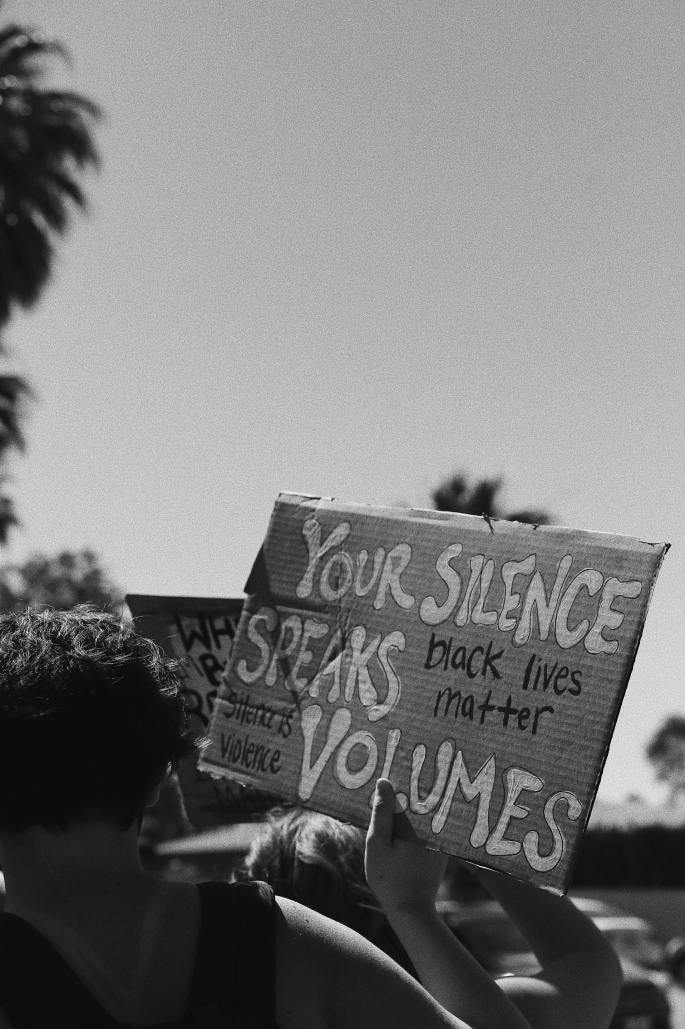
I will not be silent

I will not be silent
in the face of injustice.
I will stand up 
for the oppressed,
for people of color –
children of God.

I will stand up against
the lie of white supremacy
the sin that begat slavery
the sin that begat lynchings
the sin that begets inequality
the sin that begets injustice.

In this land where
liberty and justice
are not for all
I will protest freely
I will act justly
I will love mercy.

I will be an instrument
of Your peace.
Where there is hatred
I will sow love.
Where there is darkness
I will be light.
I will not be silent.

Pillars of Caste: Divine Will

Caste is the granting or withholding of respect, status, honor, attention, privileges, resources, benefit of the doubt, and human kindness to someone on the basis of their perceived rank or standing in the hierarchy.

Isabel Wilkerson

In Caste: The Origins of Our Discontents, Isabel Wilkerson identified eight pillars of a caste system. I would describe these “pillars” as beliefs (or excuses) that are used to justify treating one group of people as inferior to another on the basis of something as insignificant as skin color. A caste system is not necessarily based on race. It can be based on gender, age, religion, social class, etc.

The first pillar Wilkerson discussed is “divine will and the laws of nature.” She began by describing the divine justification for the Indian caste system. In an ancient Indian text, Brahma, “the grandfather of all the worlds” was said to have created the highest caste, the Brahmans, out of his mouth or head. The lower castes were said to have been formed out of lower parts of the body – the arms, the thighs, the feet. The “untouchables” were considered so low, they were even beneath the feet of the lowly Shudra, “the servant, the bearer of burdens.”

In America, Christians historically used what has been called the “curse of Ham” as justification for enslaving people with brown skin. If you read the biblical text, the curse of Ham was actually Noah’s curse of his grandson Canaan, Ham’s son. Noah was angry at Ham for telling his two brothers that he saw Noah naked. The curse was not a curse of God and it had nothing to do with Ham or Canaan’s skin color.

Christians have used selected scripture as a pillar supporting the withholding of privileges from women in ministry. One day, when a woman gave the sermon at my church, I saw a man turn to his wife and say, 1 Corinthians 14:34. I immediately knew that he was referring to the verses that have been used to justify preventing women from speaking in church. “Women should remain silent in the churches. They are not allowed to speak, but must be in submission, as the law says.”

I have struggled to understand why Paul would write that women should not be allowed to speak. I found a compelling response to the question, Are women to remain silent in the church? in a blog post by Dennis Regling, an evangelist. He wrote that Paul often quoted other people before refuting what they were saying. Paul would use the Greek symbol ἢ before refuting the previous passage. The symbol basically means nonsense! or say what?

Both of these examples illustrate how important it is to use discernment when you hear someone attempt to use the Bible to justify something that you know is not consistent with who God is. Our response should be an emphatic á¼¢. Nonsense! God created human beings in his image. We are to love one another as we love ourselves, to treat other people the way we want to be treated.

****

Photo by Alex Azabache on Unsplash

Toxins in the Permafrost

After the racial protests of 2020, I began reading to learn more about racism in America. The most informative book I have read so far is Isabel Wilkerson’s Caste: The Origins of Our Discontents. Part One of the book begins with a powerful analogy. In 2016, a heat wave hit the Russian peninsula of Yamal. So many children were getting sick from a mysterious illness, the authorities declared a state of emergency. Then scientists discovered that the extreme heat had eroded the permafrost, exposing Anthrax, a toxin that had been buried in the carcasses of reindeer since 1941.

Racism is a toxic pathogen. For much of my life, I believed that America had largely buried it. But just as unusually hot weather in Siberia exposed long-buried anthrax spores, rising heat in human hearts exposed long-denied racism in the United States. What reignited the flames? Wilkens pointed to one catalyst: the U.S. Census Bureau’s projection that by 2042, the U.S. will no longer be a white-majority nation.

The prevalence of racism today is often attributed to institutional or systemic racism, the embedded social practices that lead to discrimination against people of color. According to Wikipedia, the term institutional racism was first used in 1967 in the book Black Power: The Politics of Liberation. Institutional racism is much more subtle and harder to detect than individual racism. Today many whites quickly condemn individual racism as immoral but are not so quick to condemn the racist practices embedded in our culture.

When Martin Luther King, Jr. visited India, he was introduced to a group of high school students as “a fellow untouchable from the United States of America.” King was surprised and a bit peeved to be described as an untouchable. But he realized it was true; he and other black people had been consigned to the lowest caste in America for centuries.

A caste system is an artificial construction, a fixed and embedded ranking of human value that sets the presumed supremacy of one group against the presumed inferiority of other groups on the basis of ancestry and often immutable traits, traits that would be neutral in the abstract but are ascribed life-and-death meaning in a hierarchy favoring the dominant caste whose forebears designed it.

Isabel Wilkerson

Years ago, missionaries visited my church to talk about the Dalits, India’s lowest caste, once known as the “untouchables.” We were given clay cups to remind us of the daily oppression of the Dalit people, who aren’t allowed to drink from the same cups as people in the higher castes. The oppression of the Dalits seemed like an other world problem. Now I realize that caste is very much a part of my world. It is not a foreign problem.

In Caste, Wilkerson draws parallels between the unnamed caste system of the United States and those of India and Nazi Germany. As described by Wilkerson, the upper caste consists of white people of European descent, the middle caste is made up of Latinos, Asians, and Native Americans, and the lower or bottom caste is made up of black people of African descent. White people have historically been the dominant caste, the favored caste, the ruling majority. Black people have historically been the subordinate caste, the disfavored caste, the powerless minority.

In another powerful analogy, Wilkerson compared America to the stage of a long-running play.

The actors wear the costumes of their predecessors and inhabit the roles assigned to them. The people in these roles are not the characters they play, but they have played the roles long enough to incorporate the roles into their very being, to merge the assignment with their inner selves and how they are seen in the world.

Isabel Wilkerson, Caste

White people have become accustomed to our dominant roles. We take little notice of the people in the back unless they try to veer from the script; then we step in and put them in their place. If they protest too much, we silence them.

Caste makes distinctions among creatures where God has made none.

A native of India

The American caste system is a tragedy. As a nation, we have an ugly, horrific history of dehumanizing people based on the color of their skin. And although those of us living today did not create this system, we inherited it and may unwittingly play a role in keeping it in place.

The caste system thrives on dissension and inequality, envy and false rivalries, that build up in a world of perceived scarcity….A caste system builds rivalry and distrust and lack of empathy toward one’s fellows.

Isabel Wilkerson

Today, we can see the American caste system at work in the restrictive voting laws that are being enacted all over the country. I believe that these bills are designed to keep the ruling majority in power. Others have pointed out the symbolism of the governor of Georgia signing a bill that restricts voting rights while surrounded by white men standing in front of a painting of a slave plantation.

I agree with Wilkerson that understanding the American caste system may be the key to dismantling it. In part three of her book, Wilkerson describes what she calls the eight pillars of caste, the beliefs and practices that keep a caste system in place. I will reflect on each of these pillars in future posts.

****

Photo by Daniel Born on Unsplash